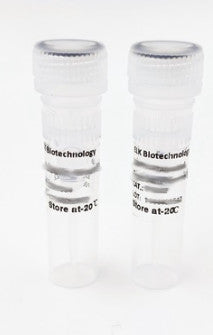
ELK Biotechnology
MK13 Rabbit Polyclonal Antibody - ES10561
MK13 Rabbit Polyclonal Antibody - ES10561
Couldn't load pickup availability
MK13 Rabbit Polyclonal Antibody
Sizes: 50μL, 100μL
Catalogue Numbers: ES10561-50, ES10561-100
Lead times: 1-2 weeks, if manufacturer has product in stock
Manufacturer/Ship Location: China
Background: This gene encodes a member of the mitogen-activated protein (MAP) kinase family. MAP kinases act as an integration point for multiple biochemical signals, and are involved in a wide variety of cellular processes such as proliferation, differentiation, transcription regulation and development. The encoded protein is a p38 MAP kinase and is activated by proinflammatory cytokines and cellular stress. Substrates of the encoded protein include the transcription factor ATF2 and the microtubule dynamics regulator stathmin. Alternatively spliced transcript variants have been observed for this gene. [provided by RefSeq, Jul 2012],
Reactivity: Human, Mouse, Rat
Host: Rabbit
Applications: WB, ELISA
Clonality: Polyclonal
Immunogen: Synthesized peptide derived from human protein. at AA range: 200-280
Isotype: IgG
Target: MK13
Specificity: MK13 Polyclonal Antibody detects endogenous levels of protein.
Dilution: WB 1:500-2000 ELISA 1:5000-20000
Purification: The antibody was affinity-purified from rabbit antiserum by affinity-chromatography using epitope-specific immunogen.
Concentration: 1 mg/ml,
Formlation: Liquid in PBS containing 50% glycerol, and 0.02% sodium azide.
Expression: Expressed in testes, pancreas, small intestine, lung and kidney, Abundant in macrophages, also present in neutrophils, CD4+ T-cells, and endothelial cells,
Observed Band (KD): 40kD
Fields: Endocrine resistance, MAPK signaling pathway, Rap1 signaling pathway, FoxO signaling pathway, Sphingolipid signaling pathway, Oocyte meiosis, Cellular senescence, Adrenergic signaling in cardiomyocytes, VEGF signaling pathway, Osteoclast differentiation, Signaling pathways regulating pluripotency of stem cells, Platelet activation, Neutrophil extracellular trap formation, Toll-like receptor signaling pathway, NOD-like receptor signaling pathway, RIG-I-like receptor signaling pathway, C-type lectin receptor signaling pathway, IL-17 signaling pathway, Th1 and Th2 cell differentiation, Th17 cell differentiation, T cell receptor signaling pathway, Fc epsilon RI signaling pathway, TNF signaling pathway, Leukocyte transendothelial migration, Thermogenesis, Neurotrophin signaling pathway, Retrograde endocannabinoid signaling, Dopaminergic synapse, Inflammatory mediator regulation of TRP channels, GnRH signaling pathway, Progesterone-mediated oocyte maturation, >
Function: Catalytic Activity: ATP + a protein = ADP + a phosphoprotein
Cofactor: Magnesium
Domain: The TXY motif contains the threonine and tyrosine residues whose phosphorylation activates the MAP kinases
Enzyme Regulation: Activated by phosphorylation on threonine and tyrosine by either of two dual specificity kinases, MAP2K3 and MAP2K6
Function: Responds to activation by environmental stress and pro-inflammatory cytokines by phosphorylating downstream targets. Plays a role in the regulation of protein translation by phosphorylating and inactivating EEF2K
PTM: Dually phosphorylated on Thr-180 and Tyr-182, which activates the enzyme
Similarity: Belongs to the protein kinase superfamily. CMGC Ser/Thr protein kinase family. MAP kinase subfamily
Similarity: Contains 1 protein kinase domain
Tissue Specificity: Expressed in testes, pancreas, small intestine, lung and kidney. Abundant in macrophages, al
Subcellular Location: intracellular, cytosol,
Storage and Stability: -20°C/1 year
Gene Name: MAPK13 PRKM13 SAPK4
Protein Name: Mitogen-activated protein kinase 13 (MAP kinase 13) (MAPK 13) (EC 2.7.11.24) (Mitogen-activated protein kinase p38 delta) (MAP kinase p38 delta) (Stress-activated protein kinase 4)
Mouse SwissProt Number: Q9Z1B7
Rat SwissProt Number: Q9WTY9
Research Use Only