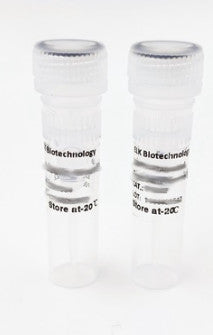
ELK Biotechnology
Crk II (phospho Tyr221) Rabbit Polyclonal Antibody - ES1448
Crk II (phospho Tyr221) Rabbit Polyclonal Antibody - ES1448
Couldn't load pickup availability
Crk II (phospho Tyr221) Rabbit Polyclonal Antibody
Sizes: 50μL, 100μL
Catalogue Numbers: ES1448-50, ES1448-100
Lead times: 1-2 weeks, if manufacturer has product in stock
Manufacturer/Ship Location: China
Background: This gene encodes a member of an adapter protein family that binds to several tyrosine-phosphorylated proteins. The product of this gene has several SH2 and SH3 domains (src-homology domains) and is involved in several signaling pathways, recruiting cytoplasmic proteins in the vicinity of tyrosine kinase through SH2-phosphotyrosine interaction. The N-terminal SH2 domain of this protein functions as a positive regulator of transformation whereas the C-terminal SH3 domain functions as a negative regulator of transformation. Two alternative transcripts encoding different isoforms with distinct biological activity have been described. [provided by RefSeq, Jul 2008],
Reactivity: Human, Mouse, Rat, Monkey
Host: Rabbit
Applications: WB, IF, ELISA
Alternate Names: CRK, Adapter molecule crk, Proto-oncogene c-Crk, p38
Clonality: Polyclonal
Immunogen: The antiserum was produced against synthesized peptide derived from human CrkII around the phosphorylation site of Tyr221. AA range:187-236
Isotype: IgG
Target: Crk II
Specificity: Phospho-Crk II (Y221) Polyclonal Antibody detects endogenous levels of Crk II protein only when phosphorylated at Y221.
Dilution: Western Blot: 1/500 - 1/2000. Immunofluorescence: 1/200 - 1/1000. ELISA: 1/40000. Not yet tested in other applications.
Purification: The antibody was affinity-purified from rabbit antiserum by affinity-chromatography using epitope-specific immunogen.
Concentration: 1 mg/ml,
Formlation: Liquid in PBS containing 50% glycerol, 0.5% BSA and 0.02% sodium azide.
Expression: Embryonic lung, Epithelium, Eye, Lung, Placenta,
Observed Band (KD): 40kD
Fields: MAPK signaling pathway, ErbB signaling pathway, Rap1 signaling pathway, Chemokine signaling pathway, Focal adhesion, Fc gamma R-mediated phagocytosis, Neurotrophin signaling pathway, Regulation of actin cytoskeleton, Insulin signaling pathway, Growth hormone synthesis, secretion and action, Bacterial invasion of epithelial cells, Shigellosis, Yersinia infection, Human cytomegalovirus infection, Human immunodeficiency virus 1 infection, Pathways in cancer, MicroRNAs in cancer, Renal cell carcinoma, Chronic myeloid leukemia
Function: Domain: The C-terminal SH3 domain function as a negative modulator for transformation and the N-terminal SH3 domain appears to function as a positive regulator for transformation
Domain: The SH2 domain mediates interaction with SHB
Function: The Crk-I and Crk-II forms differ in their biological activities. Crk-II has less transforming activity than Crk-I. Crk-II mediates attachment-induced MAPK8 activation, membrane ruffling and cell motility in a Rac-dependent manner. Involved in phagocytosis of apoptotic cells and cell motility via its interaction with DOCK1 and DOCK4
PTM: Phosphorylated on Tyr-221 upon cell adhesion. Results in the negative regulation of the association with SH2- and SH3-binding partners, possibly by the formation of an intramolecular interaction of phosphorylated Tyr-221 with the SH2 domain. This leads finally to the down-regulation of the Crk signaling pathway
PTM: P
Subcellular Location: Cytoplasm Cell membrane Translocated to the plasma membrane upon cell adhesion
Storage and Stability: -20°C/1 year
Gene Name: CRK
Protein Name: Adapter molecule crk
Mouse Gene ID: 12928
Mouse SwissProt Number: Q64010
Rat Gene ID: 54245
Rat SwissProt Number: Q63768
Research Use Only