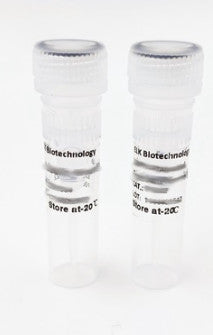
ELK Biotechnology
GK1 Rabbit Polyclonal Antibody - ES2428
GK1 Rabbit Polyclonal Antibody - ES2428
Couldn't load pickup availability
GK1 Rabbit Polyclonal Antibody
Sizes: 50μL, 100μL
Catalogue Numbers: ES2428-50, ES2428-100
Lead times: 1-2 weeks, if manufacturer has product in stock
Manufacturer/Ship Location: China
Background: The protein encoded by this gene belongs to the FGGY kinase family. This protein is a key enzyme in the regulation of glycerol uptake and metabolism. It catalyzes the phosphorylation of glycerol by ATP, yielding ADP and glycerol-3-phosphate. Mutations in this gene are associated with glycerol kinase deficiency (GKD). Alternatively spliced transcript variants encoding different isoforms have been found for this gene. [provided by RefSeq, Mar 2011],
Reactivity: Human, Mouse, Rat
Host: Rabbit
Applications: WB, IF, ELISA
Alternate Names: GK, Glycerol kinase, GK, Glycerokinase, ATP:glycerol 3-phosphotransferase
Clonality: Polyclonal
Immunogen: The antiserum was produced against synthesized peptide derived from human GK. AA range:461-510
Isotype: IgG
Target: GK1
Specificity: GK1 Polyclonal Antibody detects endogenous levels of GK1 protein.
Dilution: Western Blot: 1/500 - 1/2000. Immunofluorescence: 1/200 - 1/1000. ELISA: 1/20000. Not yet tested in other applications.
Purification: The antibody was affinity-purified from rabbit antiserum by affinity-chromatography using epitope-specific immunogen.
Concentration: 1 mg/ml,
Formlation: Liquid in PBS containing 50% glycerol, 0.5% BSA and 0.02% sodium azide.
Expression: Highly expressed in the liver, kidney and testis, Isoform 2 and isoform 3 are expressed specifically in testis and fetal liver, but not in the adult liver,
Observed Band (KD): 57kD
Fields: Glycerolipid metabolism, Metabolic pathways, PPAR signaling pathway
Function: Catalytic Activity: ATP + glycerol = ADP + sn-glycerol 3-phosphate
Caution: The sequence shown here is derived from an Ensembl automatic analysis pipeline and should be considered as preliminary data
Disease: Defects in GK are the cause of GK deficiency (GKD) [MIM: 307030]. This disease can be either symptomatic with episodic metabolic and CNS decompensation or asymptomatic with hyperglycerolemia and hyperglyceroluria only
Function: Key enzyme in the regulation of glycerol uptake and metabolism
Pathway: Polyol metabolism, glycerol degradation via glycerol kinase pathway, sn-glycerol 3-phosphate from glycerol: step 1/1
Similarity: Belongs to the FGGY kinase family
Subcellular Location: In sperm and fetal tissues, the majority of the enzyme is bound to mitochondria, but in adult tissues, such as liver found in the cytoplasm
Tissue Specificity: Highly expressed in the liver, kidney and testis
Subcellular Location: Mitochondrion outer membrane, Peripheral membrane protein, Cytoplasmic side Cytoplasm In sperm and fetal tissues, the majority of the enzyme is bound to mitochondria, but in adult tissues, such as liver found in the cytoplasm
Storage and Stability: -20°C/1 year
Gene Name: GK
Protein Name: Glycerol kinase
Mouse Gene ID: 14933
Mouse SwissProt Number: Q64516
Rat Gene ID: 79223
Rat SwissProt Number: Q63060
Research Use Only