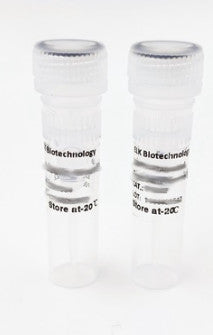
ELK Biotechnology
Histone H2B (phospho-Ser14) Rabbit Polyclonal Antibody - ES15736
Histone H2B (phospho-Ser14) Rabbit Polyclonal Antibody - ES15736
Couldn't load pickup availability
Histone H2B (phospho-Ser14) Rabbit Polyclonal Antibody
Sizes: 50μL, 100μL
Catalogue Numbers: ES15736-50, ES15736-100
Lead times: 1-2 weeks, if manufacturer has product in stock
Manufacturer/Ship Location: China
Background: Histones are basic nuclear proteins that are responsible for the nucleosome structure of the chromosomal fiber in eukaryotes. Two molecules of each of the four core histones (H2A, H2B, H3, and H4) form an octamer, around which approximately 146 bp of DNA is wrapped in repeating units, called nucleosomes. The linker histone, H1, interacts with linker DNA between nucleosomes and functions in the compaction of chromatin into higher order structures. This gene is intronless and encodes a replication-dependent histone that is a member of the histone H2B family. Transcripts from this gene lack polyA tails but instead contain a palindromic termination element. This gene is found in the large histone gene cluster on chromosome 6. [provided by RefSeq, Aug 2015],
Reactivity: Human, Rat, Mouse,
Host: Rabbit
Applications: WB
Alternate Names: Histone H2B type 1-H (Histone H2B.j) (H2B/j)
Clonality: Polyclonal
Immunogen: Synthesized phosho peptide around human Histone H2B (Ser14)
Isotype: IgG
Target: Histone H2B
Specificity: This antibody detects endogenous levels of Human Histone H2B (phospho-Ser14)
Dilution: WB 1:1000-2000
Purification: The antibody was affinity-purified from rabbit serum by affinity-chromatography using specific immunogen.
Concentration: 1 mg/ml,
Formlation: Liquid in PBS containing 50% glycerol, 0.5% BSA and 0.02% sodium azide.
Expression: Epithelium,
Observed Band (KD): 18kD
Fields: Neutrophil extracellular trap formation, Alcoholism, Viral carcinogenesis, Systemic lupus erythematosus
Function: Function: Core component of nucleosome. Nucleosomes wrap and compact DNA into chromatin, limiting DNA accessibility to the cellular machineries which require DNA as a template. Histones thereby play a central role in transcription regulation, DNA repair, DNA replication and chromosomal stability. DNA accessibility is regulated via a complex set of post-translational modifications of histones, also called histone code, and nucleosome remodeling
PTM: Monoubiquitination of Lys-121 by the RNF20/40 complex gives a specific tag for epigenetic transcriptional activation and is also prerequisite for histone H3 'Lys-4' and 'Lys-79' methylation. It also functions cooperatively with the FACT dimer to stimulate elongation by RNA polymerase II
PTM: Phosphorylated on Ser-15 by STK4/MST1 during apoptosis, which facilitates apoptotic chromatin condensation. Also phosphorylated on Ser-15 in response to DN
Subcellular Location: Nucleus Chromosome
Storage and Stability: -20°C/1 year
Gene Name: HIST1H2BH H2BFJ
Protein Name: Histone H2B (Ser14)
Mouse Gene ID: 319182
Mouse SwissProt Number: Q64478
Research Use Only