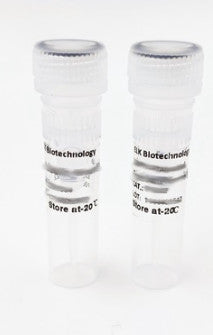
ELK Biotechnology
PHF6 Rabbit Polyclonal Antibody - ES9986
PHF6 Rabbit Polyclonal Antibody - ES9986
Couldn't load pickup availability
PHF6 Rabbit Polyclonal Antibody
Sizes: 50μL, 100μL
Catalogue Numbers: ES9986-50, ES9986-100
Lead times: 1-2 weeks, if manufacturer has product in stock
Manufacturer/Ship Location: China
Background: This gene is a member of the plant homeodomain (PHD)-like finger (PHF) family. It encodes a protein with two PHD-type zinc finger domains, indicating a potential role in transcriptional regulation, that localizes to the nucleolus. Mutations affecting the coding region of this gene or the splicing of the transcript have been associated with Borjeson-Forssman-Lehmann syndrome (BFLS), a disorder characterized by mental retardation, epilepsy, hypogonadism, hypometabolism, obesity, swelling of subcutaneous tissue of the face, narrow palpebral fissures, and large ears. Alternate splicing results in multiple transcript variants, encoding different isoforms. [provided by RefSeq, Jun 2010],
Reactivity: Human, Mouse
Host: Rabbit
Applications: WB, ELISA
Clonality: Polyclonal
Immunogen: Synthesized peptide derived from human protein. at AA range: 290-370
Isotype: IgG
Target: PHF6
Specificity: PHF6 Polyclonal Antibody detects endogenous levels of protein.
Dilution: WB 1:500-2000 ELISA 1:5000-20000
Purification: The antibody was affinity-purified from rabbit antiserum by affinity-chromatography using epitope-specific immunogen.
Concentration: 1 mg/ml,
Formlation: Liquid in PBS containing 50% glycerol, and 0.02% sodium azide.
Expression: Ubiquitously expressed,
Observed Band (KD): 40kD
Function: Disease: Defects in PHF6 are the cause of Boerjeson-Forssman-Lehmann syndrome (BFLS) [MIM: 301900], also known as Boerjeson-Forssman syndrome (BORJ). BFLS is a X-linked recessive disorder characterized by moderate to severe mental retardation, epilepsy, hypogonadism, hypometabolism, obesity with marked gynecomastia, swelling of subcutaneous tissue of the face, narrow palpebral fissure and large but not deformed ears
Function: May play a role in transcriptional regulation
PTM: Phosphorylated upon DNA damage, probably by ATM or ATR
Similarity: Contains 2 PHD-type zinc fingers
Subcellular Location: Nuclear, it particularly localizes to the nucleolus
Tissue Specificity: Ubiquitously expressed
Subcellular Location: Nucleus Nucleus, nucleolus Chromosome, centromere, kinetochore Nuclear, it particularly localizes to the nucleolus
Storage and Stability: -20°C/1 year
Gene Name: PHF6 KIAA1823
Protein Name: PHD finger protein 6 (PHD-like zinc finger protein)
Mouse SwissProt Number: Q9D4J7
Research Use Only