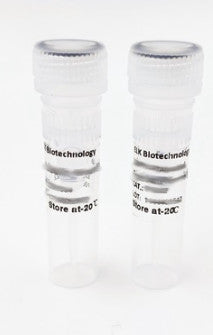
ELK Biotechnology
PKC ζ Rabbit Polyclonal Antibody - ES3226
PKC ζ Rabbit Polyclonal Antibody - ES3226
Couldn't load pickup availability
PKC ζ Rabbit Polyclonal Antibody
Sizes: 50μL, 100μL
Catalogue Numbers: ES3226-50, ES3226-100
Lead times: 1-2 weeks, if manufacturer has product in stock
Manufacturer/Ship Location: China
Background: Protein kinase C (PKC) zeta is a member of the PKC family of serine/threonine kinases which are involved in a variety of cellular processes such as proliferation, differentiation and secretion. Unlike the classical PKC isoenzymes which are calcium-dependent, PKC zeta exhibits a kinase activity which is independent of calcium and diacylglycerol but not of phosphatidylserine. Furthermore, it is insensitive to typical PKC inhibitors and cannot be activated by phorbol ester. Unlike the classical PKC isoenzymes, it has only a single zinc finger module. These structural and biochemical properties indicate that the zeta subspecies is related to, but distinct from other isoenzymes of PKC. Alternative splicing results in multiple transcript variants encoding different isoforms. [provided by RefSeq, Jul 2008],
Reactivity: Human, Mouse, Rat, Monkey
Host: Rabbit
Applications: WB, IHC, IF, ELISA
Alternate Names: PRKCZ, PKC2, Protein kinase C zeta type, nPKC-zeta
Clonality: Polyclonal
Immunogen: The antiserum was produced against synthesized peptide derived from human PKC zeta. AA range:526-575
Isotype: IgG
Target: PKC ζ
Specificity: PKC ζ Polyclonal Antibody detects endogenous levels of PKC ζ protein.
Dilution: Western Blot: 1/500 - 1/2000. Immunohistochemistry: 1/100 - 1/300. Immunofluorescence: 1/200 - 1/1000. ELISA: 1/5000. Not yet tested in other applications.
Purification: The antibody was affinity-purified from rabbit antiserum by affinity-chromatography using epitope-specific immunogen.
Concentration: 1 mg/ml,
Formlation: Liquid in PBS containing 50% glycerol, 0.5% BSA and 0.02% sodium azide.
Expression: Expressed in brain, and to a lesser extent in lung, kidney and testis,
Observed Band (KD): 80kD
Fields: Rap1 signaling pathway, Chemokine signaling pathway, Sphingolipid signaling pathway, Endocytosis, Axon guidance, Hippo signaling pathway, Tight junction, Platelet activation, Insulin signaling pathway, Relaxin signaling pathway, Type II diabetes mellitus, Insulin resistance, AGE-RAGE signaling pathway in diabetic complications, Human papillomavirus infection, Diabetic cardiomyopathy, Fluid shear stress and atherosclerosis
Function: Catalytic Activity: ATP + a protein = ADP + a phosphoprotein
Domain: The C1 domain does not bind the diacylglycerol (DAG)
Domain: The OPR domain mediates mutually exclusive interactions with SQSTM1 and PARD6B
Enzyme Regulation: Phosphatidylinositol 3,4,5-trisphosphate might be a physiological activator. Two specific sites, Thr-410 (activation loop of the kinase domain) and Thr-560 (turn motif), need to be phosphorylated for its full activation
Function: PKC is activated by diacylglycerol which in turn phosphorylates a range of cellular proteins. PKC also serves as the receptor for phorbol esters, a class of tumor promoters. Subunit of a quaternary complex that plays a central role in epithelial cell polarization
Function: This is a calcium-independent, phospholipid-dependent, serine- and threonine-specific enzyme
Similarity: Belongs to the protein kinase superfamily
Similarity: Belongs to
Subcellular Location: Cytoplasm Endosome Cell junction Membrane, Peripheral membrane protein In the retina, localizes in the terminals of the rod bipolar cells (By similarity) Associates with endosomes (PubMed:9566925) Presence of KRIT1, CDH5 and RAP1B is required for its localization to the cell junction (PubMed:7597083) Colocalizes with VAMP2 and WDFY2 in intracellular vesicles (PubMed:17313651) Transiently translocates to the membrane of CA1 hippocampal cells in response to the induction of long term potentiation (By similarity), [Isoform 2]: Cytoplasm
Storage and Stability: -20°C/1 year
Gene Name: PRKCZ
Protein Name: Protein kinase C zeta type
Mouse Gene ID: 18762
Mouse SwissProt Number: Q02956
Rat Gene ID: 25522
Rat SwissProt Number: P09217
Research Use Only