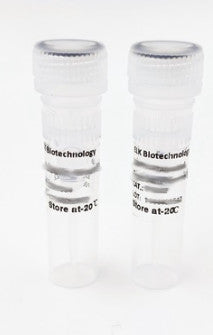
ELK Biotechnology
TRYB1 Rabbit Polyclonal Antibody - ES11973
TRYB1 Rabbit Polyclonal Antibody - ES11973
Couldn't load pickup availability
TRYB1 Rabbit Polyclonal Antibody
Sizes: 50μL, 100μL
Catalogue Numbers: ES11973-50, ES11973-100
Lead times: 1-2 weeks, if manufacturer has product in stock
Manufacturer/Ship Location: China
Background: Tryptases comprise a family of trypsin-like serine proteases, the peptidase family S1. Tryptases are enzymatically active only as heparin-stabilized tetramers, and they are resistant to all known endogenous proteinase inhibitors. Several tryptase genes are clustered on chromosome 16p13.3. These genes are characterized by several distinct features. They have a highly conserved 3' UTR and contain tandem repeat sequences at the 5' flank and 3' UTR which are thought to play a role in regulation of the mRNA stability. These genes have an intron immediately upstream of the initiator Met codon, which separates the site of transcription initiation from protein coding sequence. This feature is characteristic of tryptases but is unusual in other genes. The alleles of this gene exhibit an unusual amount of sequence variation, such that the alleles were once thought to represent two separate gene
Reactivity: Human, Mouse, Rat
Host: Rabbit
Applications: WB, ELISA
Clonality: Polyclonal
Immunogen: Synthesized peptide derived from part region of human protein AA range: 200-250
Isotype: IgG
Target: Mast cell tryptase
Specificity: TRYB1 Polyclonal Antibody detects endogenous levels of protein.
Dilution: WB 1:500-2000 ELISA 1:5000-20000
Purification: The antibody was affinity-purified from rabbit antiserum by affinity-chromatography using epitope-specific immunogen.
Concentration: 1 mg/ml,
Formlation: Liquid in PBS containing 50% glycerol, and 0.02% sodium azide.
Expression: Isoform 1 and isoform 2 are expressed in lung, stomach, spleen, heart and skin, in these tissues, isoform 1 is predominant, Isoform 2 is expressed in aorta, spleen, and breast tumor, with highest levels in the endothelial cells of some blood vessels surrounding the aorta, as well as those surrounding the tumor and low levels, if any, in mast cells (at protein level),
Observed Band (KD): 30kD
Fields: Influenza A
Function: Catalytic Activity: Preferential cleavage: Arg-|-Xaa, Lys-|-Xaa, but with more restricted specificity than trypsin
Function: Tryptase is the major neutral protease present in mast cells and is secreted upon the coupled activation-degranulation response of this cell type
Function: Tryptase is the major neutral protease present in mast cells and is secreted upon the coupled activation-degranulation response of this cell type. Has an immunoprotective role during bacterial infection. Required to efficiently combat K.pneumoniae infection
polymorphism: There are two alleles, beta-II and beta-III which differ by 3 residues
Similarity: Belongs to the peptidase S1 family
Similarity: Belongs to the peptidase S1 family. Tryptase subfamily
Similarity: Contains 1 peptidase S1 domain
Subcellular Location: Released from the secretory granules upon mast cell activation
Subunit: Homotetramer
Subcellular Location: Secreted Released from the secretory granules upon mast cell activation
Storage and Stability: -20°C/1 year
Gene Name: TPSAB1 TPS1 TPS2 TPSB1
Protein Name: Tryptase alpha/beta-1 (Tryptase-1) (EC 3.4.21.59) (Tryptase I) (Tryptase alpha-1)
Mouse SwissProt Number: Q02844
Rat SwissProt Number: P27435
Research Use Only