Idylle
Anti-TeloG4 - Antibody Against the Telomeric G-quadruplex -
Anti-TeloG4 - Antibody Against the Telomeric G-quadruplex -
Couldn't load pickup availability
Anti-TeloG4 is an antibody that selectively recognizes the antiparallel topology of the telomeric G-quadruplex sequence.
50µL (IDY-ATG4-50)
IDY-ATG4-50 (50µL)
Key Features:
- Specific to telomeric G-quaduplex
- High affinity with a Kd around 10nM
- Compatible with immunocytochemistry
Specifications of Anti-TeloG4
Host/isotype: Human /IgG1/K
Class: monoclonal (recombinant)
Conjugate: unconjugated
Concentration: 1mg/mL
Storage buffer: PBS, pH=7,4
Specificity: Anti-TeloG4 has a high affinity for telomeric antiparallel G-quadruplex, with no detectable binding to other types of G-quadruplexes (parallel, or non telomeric), RNA G-quadruplexes, double-stranded DNA or single-stranded RNA, and low affinity to single-stranded DNA.
Affinity: The dissociation constant (Kd) for antiparallel G-quadruplex telomeric region is around 10nM.
Applications of Anti-TeloG4
Immunocytochemistry (ICC) - Use Anti-TeloG4 at 2µg/mL (1/500 dilution)
Enzyme-linked immunosorbent assay (ELISA) - Use Anti-TeloG4 at 0.25 - 1.25µg/mL (1/800 - 1/4000 dilution) depending on the target
Results
High selectivity of Anti-TeloG4 to antiparallel telomeric G-quadruplexes
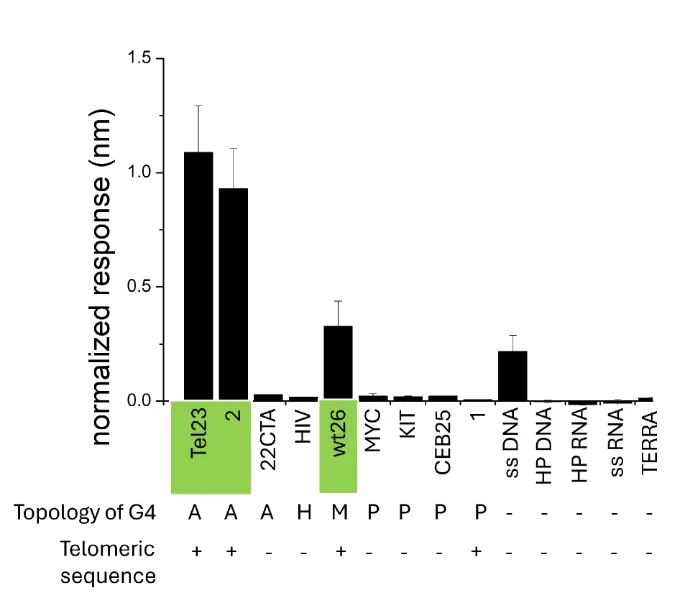
Normalized response obtained from BioLayer Interferometry (BLI) for the binding of Anti-TeloG4 with different sequences, revealing a higher affinity to antiparallel telomeric sequences (Tel23, 2, Wt26), compared to non-telomeric or parallel G-quadruplexes sequences. (Legend: Topology of G4 : Antiparallel (A), Hybrid (H), Mixture of parallel and antiparallel (M), Parallel (P); Telomeric sequence: Yes (+), No (-).
Data was adapted from Reda et al, 2025
Visualization of telomeric G4 structures by immunocytochemistry with Anti-TeloG4
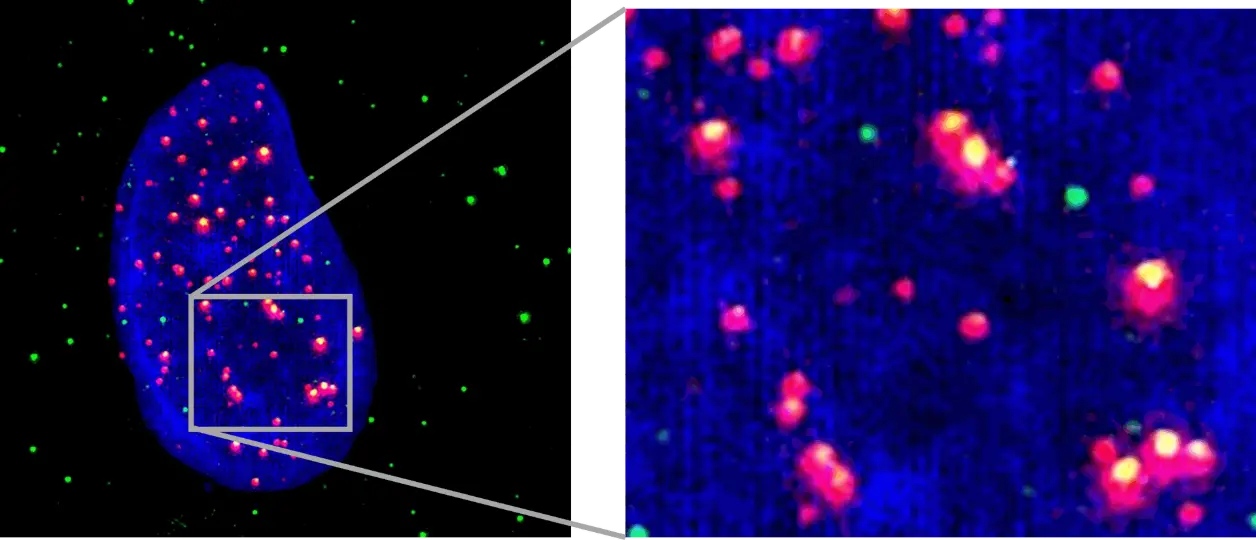
Co-localization of TRF2 telomeric protein (red) and Anti-TeloG4 (green) signals in human cancer cells (U2OS)
Data was adapted from Reda et al, 2025
Significant variation of signal from Anti-TeloG4 upon treatment with G4 ligands
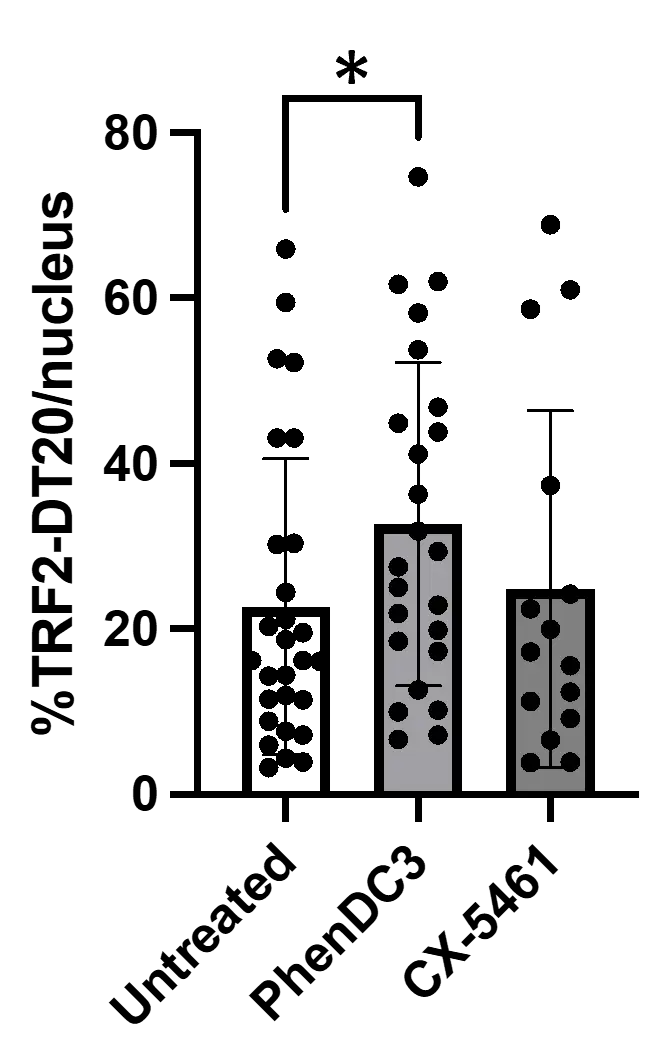
Quantification of TRF2 foci (telomeric protein) co-localizing with Anti-TeloG4 in untreated condition and treated with PhenDC3, a G4 ligand known to preferentially bind telomeric G4 structures, or with CX-5461, a G4 ligand primarily targeting ribosomal DNA sequences. This result strongly suggests that Anti-TeloG4 preferentially binds to antiparallel G4 structures stabilized at telomeres.
Data was obtained from Reda et al, 2025